The most helpful spiritual work I have ever read
I don’t mean that title to be click bait; it’s just that I couldn’t find any other title that would work. After all, “This book changed my life!” is a sentiment I have expressed many times in the 31 years since my reversion, and each time it has been true. I wrote about some of those life-changing books here, here, here, and here. And on Facebook and elsewhere, I have gushed over other books that will never leave me, such as Under the Gaze of God, by Blessed Fr. Edward Poppe; The Spiritual Life and Prayer According to Scripture and Monastic Tradition, by Cécile Bruyerè, O.S.B.; Theology and Sanity, by Frank Sheed—and so many others.
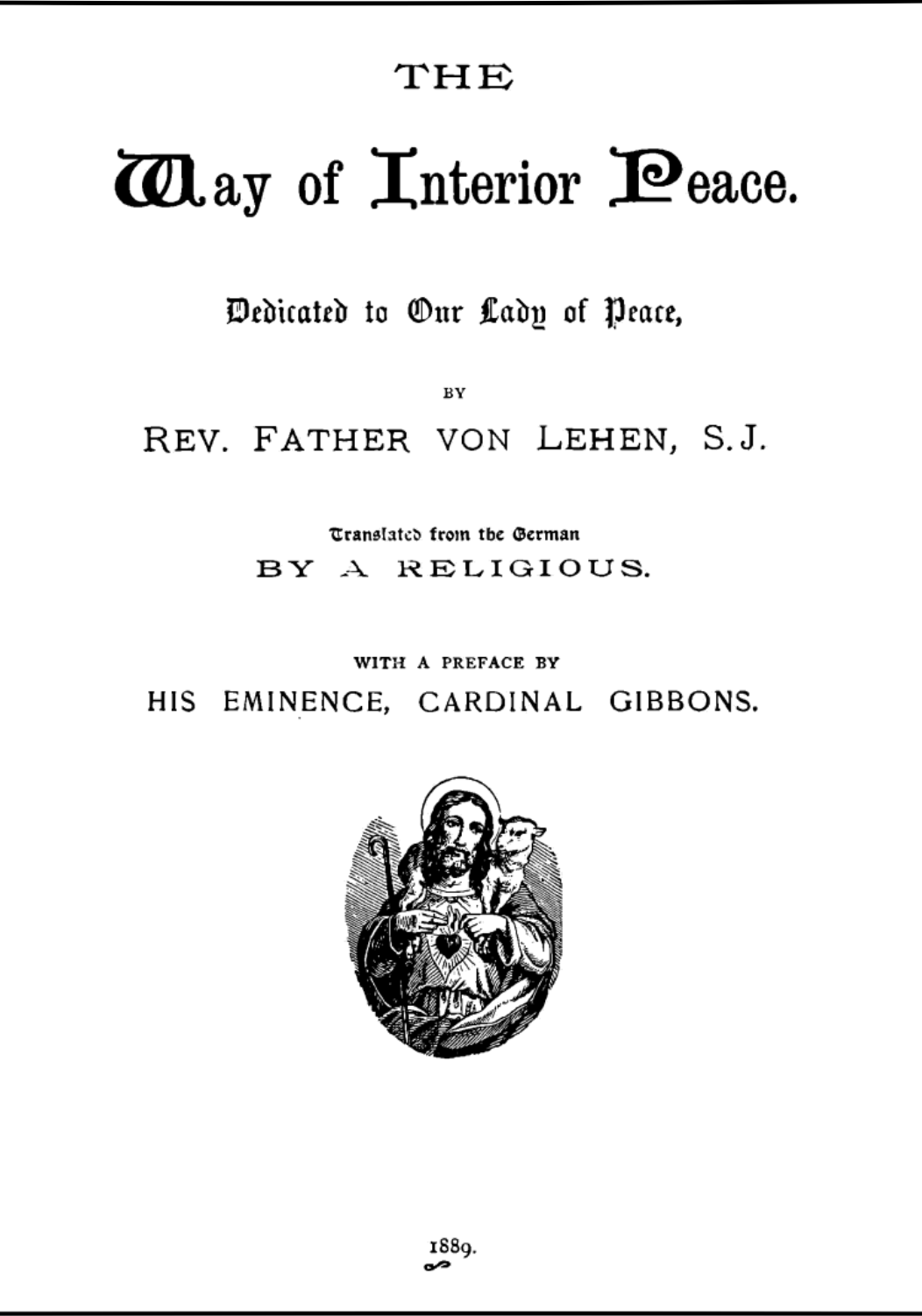
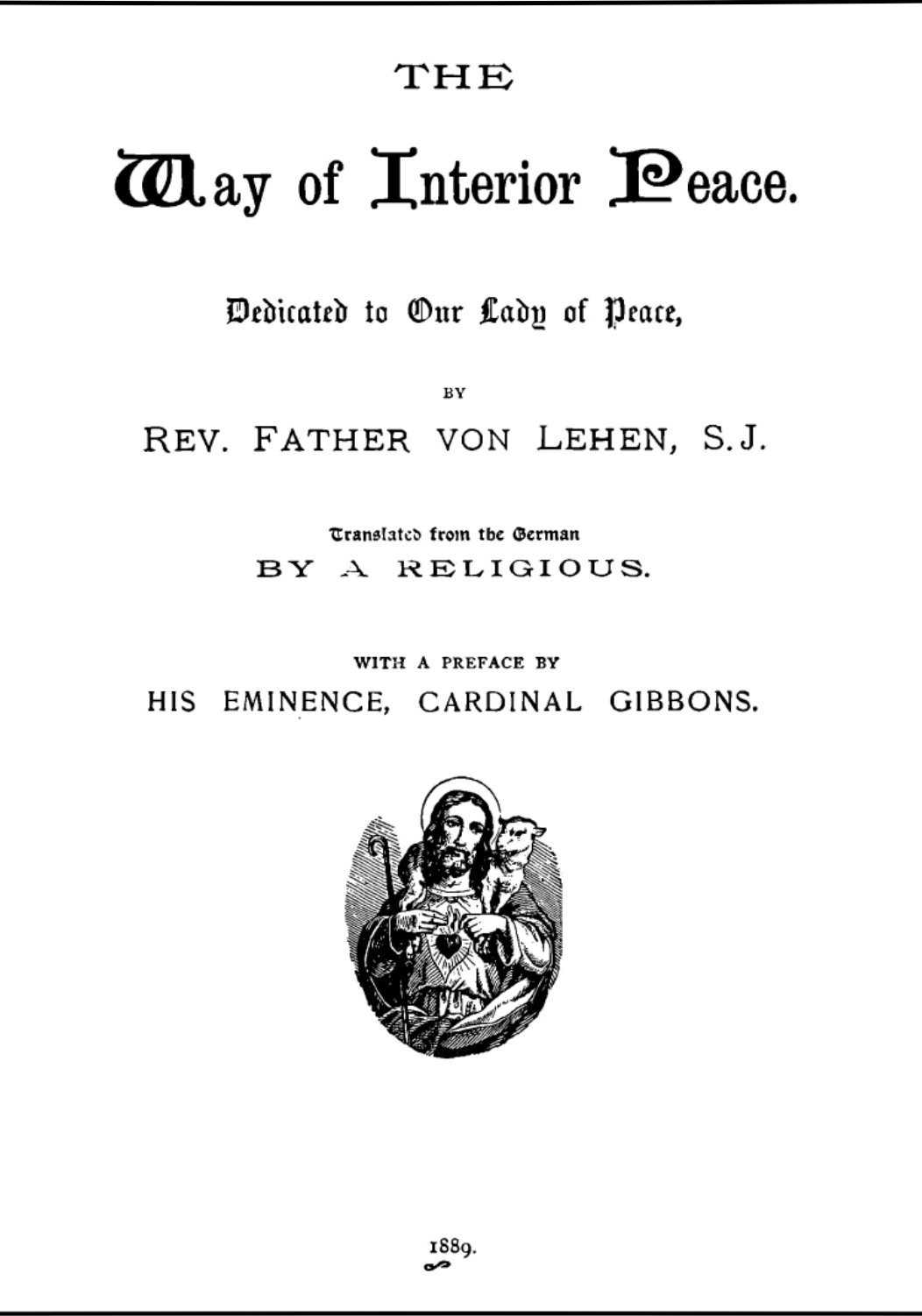
However, this 19th Century work, The Way of Interior Peace, by Father von Lehen, S.J.—which I affectionately refer to as simply “the green book” (see image below and you will understand!)— is a bit different. This book not only lays out life-changing spiritual and doctrinal truths with sparkling clarity, simplicity, and depth, but it has been, hands down, the most practical of any such life-changing book I have ever read.
Why practical? Because, instead of simply stating myriad meaty and beautiful Christian truths such as “we must detach from earthly comforts in order to attach to the Lord” or “the cross is our ladder to Heaven,” this book provides the nuts-and-bolts how of things, even to the point of breaking down spiritual truths into numbered points, with crisp distinctions and delineations. The author holds our hand through it all, instructing us how to think and proceed according to the perennial Mind of the Church, one step building on the next, and always with the aim of bringing Christ’s peace to an anxious soul.
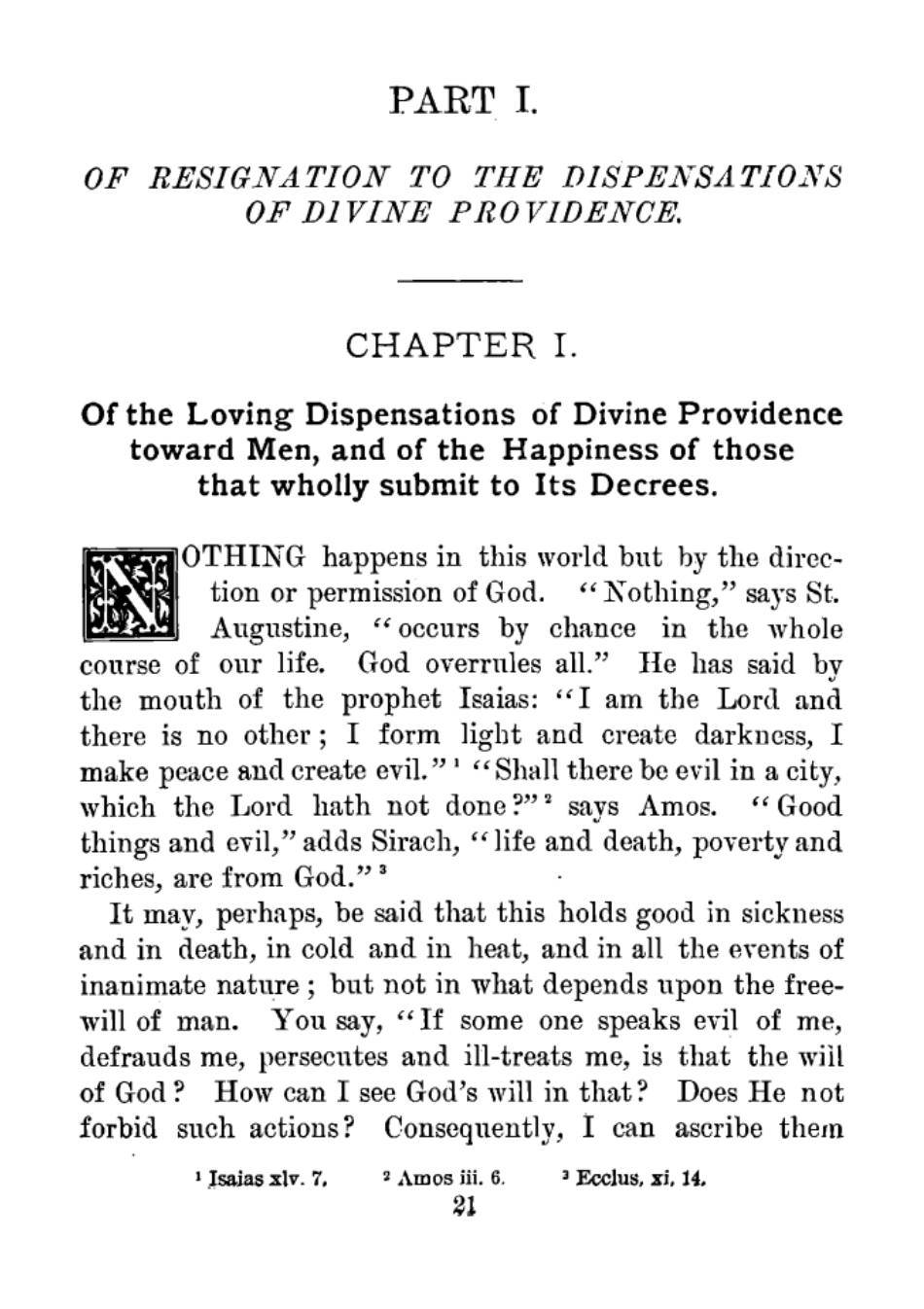
For example, we learn from the first lines of Part I, Chapter I (see image below) that nothing in our lives happens to us by chance—ever. We learn right off the bat the foundational truth that God’s Providence rules all. Modern minds can recoil from this truth in a dozen different ways, and so the standard response of the modern faithful Catholic has been immediately to distinguish between God’s active will and His merely permissive will. These distinctions certainly are important in the theological realm, yes, but the book explains what that underlying theology means in our day-to-day reality and practice.
The author, using Scripture, Church teaching, and the writings of the saints and spiritual masters, breaks everything down into simple parts not often thought of, including the distinction between an act (an arm moving to strike a person, let’s say) and the heart/will/intent of the person committing the act (which can be filled with malice). God wills the former, but not the malice of the latter—even though the two are combined at once. My eyes were opened to see everything—even every sinful act—differently, which changes the landscape of the mind and soul and floods both with peace.
For another example, in Part III, Chapter III on discouragement, we first find out what discouragement is and is not, then we learn why discouragement causes so much harm, and finally we learn how to combat discouragement, again in the most practical, concrete terms. (Who in these days couldn’t use that?)
The same eye-opening treatment is given on the subjects of temptations, the faults of others, spiritual weaknesses, and much more. The amount of underlining, annotating, stars, arrows, exclamation points and “wow!” and “THIS!” and “gasp!!” I have written in the margins is a bit over-the-top, to be honest. But that’s how much wonder and excitement this work wrought in my soul.
Scrupulosity
The most astonishing rarity of the book is the last section, Part IV, “Of Scruples.” Guys, I don’t know about you, but I know and love people who suffer or have suffered intensely from the spiritual affliction of scrupulosity—constantly tortured by the thought that they are in mortal sin when in fact they are not, and never able to feel forgiven, even after obsessive confessions. Scrupulosity is said to be the worst spiritual affliction one can endure, and I believe that. Severe scrupulosity will drive a soul from Christ and His Church, and it was the cause of Martin Luther’s ultimate revolt against the Church and the shipwreck of Christendom (the book briefly covers that fascinating history), and yet, these days at least, we rarely talk about it, and when we do, we have a very poor understanding with almost no effective or expert resources to combat it. It is practically a miracle for a scrupulous soul to find a priest who is both well-versed in its causes and remedies and also has the time and energy to take on such a soul as a spiritual directee.
But now there is hope via this section of “self-help”! Look how amazing the scruples section is:
First, the author defines scruples, including the difference between a scrupulous person and a pious person (because if we don’t know better, they can look the same, can’t they?). Next, he enumerates and explains the several causes of scruples (it’s not just one thing, and it may be different for different souls). Then, he goes over the dangerous consequences of scruples. Finally, he names the remedies for scruples, which are different depending on the kind of scruples with which one suffers. In total, there are 76 pages of teaching and counsel on scruples, which, frankly, will help any and all anxious souls, even those who do not suffer from scrupulosity.
Brilliant!
I wish every parish priest would read and study this section, because there are many parishioners suffering terribly from scrupulosity, sitting in the pews every week right along with the lax—and the scrupulous need a vastly different spiritual approach than the lax.
I could go on and on about the bombshells and subtleties I have learned from this hidden classic, but you get my point. It’s thorough, it’s uncommon in its practical instruction, and its countless illuminations flood the soul with peace and understanding. This book was written in an age (the 1880s) that we would expect to find stern and stricter than our own (and in some ways, it is), but the work itself is steeped in a remarkable mercy that I did not expect. Fr. von Lehen wrote his book in French, then it was translated into German (a popular work in both nations), and finally into English, with a preface by the esteemed and holy James Cardinal Gibbons of Baltimore, who is to this day one of the most respected American prelates in history (and only her second cardinal!).
While the cover of my “green book” is a new, self-published design (there are other versions out there), the interior guts of the book are a photographic reprint of the 1889 English edition, and visually I love that style. Because the book was written and translated almost 150 years ago, the language can sometimes trip up a modern American reader. It is not a hard read, however, so don’t worry! They wrote much better back then than we do now! When I occasionally stumbled across a word I didn’t know, I just looked it up and added it to my vocabulary (which most Americans can benefit from, I say!).
I do tell everyone who reads it to understand that the words “sense” or “sensible” (recurring often in the book) mean something different from how we use them today. While we moderns might read those words and think “common sense” or “reasonable,” they actually refer to our literal bodily senses, the corporal things (as opposed to supernatural or spiritual things). And so, for example, when the author talks of someone desiring or experiencing “sensible devotion,” he’s talking about how it hits our bodily senses and perceptions, including our feelings and emotions. He is cautioning us against a desire for “what we get out of it,” or looking to “how the prayer or act makes us feel” as a measure of our Faith or interior life. Unlike so many modern spiritual works (and the poor direction of a million online Catholic “influencers”), the “sensible” (feelings) part of things is, in this book, correctly relegated to an incidental (even ignore-able) part of our interior lives. As someone who has spent decades trying to move folks from “feelings” to Truth, I say how refreshing and rightly ordered!
And because, as St. Thomas Aquinas says, “peace is the tranquility of order,” I believe the beautiful order of this book will help bring about the peace it promises in its title to all who take it up seriously and prayerfully. I can’t describe to you the fullness of the following statement, but I will tell you that I love Jesus Christ so much more after reading (studying!) The Way of Interior Peace, and I am eternally grateful to God that I stumbled upon it by “accident” (Providence!). There is a reason it was hailed as a classic in its own time, and I pray that it enjoys a renaissance in ours!
Pax!